
✉︎ info@nordicsunwall.com
✉︎ info@nordicsunwall.com
How It Works — Nordic Sunwall
The Myth vs. The Reality
The myth: "Solar heating only works in warm, sunny climates."
The reality: Our collectors do not need warm air — they need sunlight. Even on a clear winter day at -15°C, the sun delivers 400–700 Watts of energy per square metre directly onto your wall.
The perforated black aluminium absorber converts up to 83% of that energy into usable heat. The outside temperature is almost irrelevant — the plate simply needs to be warmer than the air passing through it. On a sunny day at -10°C, the metal reaches 60–80°C. That is more than enough to preheat your ventilation air.
Key point: The system captures solar radiation, not air temperature.
Unlike heat pumps — which require a large investment and run on expensive electricity — Nordic Sunwall uses free sunlight. For one purpose: preheating the fresh air that your building already needs to bring in.
The Simple Physics
Think of it as a large, silent radiator mounted on your south-facing wall.
Step 1: Sunlight heats the metal
The matte black aluminium absorbs up to 95% of the solar energy that hits it. The metal temperature rises quickly — well above the outside temperature.
Step 2: The fan creates suction
A quiet fan pulls a slight vacuum behind the plate. This negative pressure draws cold outside air in through thousands of precisely engineered micro-perforations.
Step 3: Air pulls heat from the metal
The perforation pattern creates intense micro-turbulence. This turbulence strips away the thin "boundary layer" of heat that clings to the metal. The air absorbs the heat almost instantly — far more effectively than through larger, simpler openings.
Step 4: Warm air enters your building
The heated air rises in the insulated cavity behind the plate and is blown directly into your existing ventilation system. Your gas or electric heater sees this preheated air and works significantly less.
Step 5 (Optional): Thermal storage
For evening use, an optional thermal battery stores excess daytime heat and releases it for 6–7 hours after sunset.
Winter, Clouds, and Night (The Questions Everyone Asks)
Does it work when it is freezing outside?
Yes. The system needs sunlight, not warm air. On a clear winter day at -15°C, the sun is strong enough to heat the black metal to 40–50°C. The air passing through rises to 25–35°C — more than enough to take the chill off your ventilation air.
What happens on cloudy days?
The plate still captures diffuse sunlight. The temperature rise is lower (maybe 5–10°C), but it still contributes. On heavily overcast days, the system simply switches off via a temperature controller, and your existing heating system works normally. There is no risk of cold air entering your building.
What about rain, snow, and wind?
The aluminium is corrosion-resistant and built for outdoor use. Rain washes away dust, which actually improves performance. Snow slides off the dark surface as soon as it warms up — within an hour of sunrise, your panel is clear. Systems with glass or polycarbonate struggle much more with snow. The plate itself acts as a windbreak, protecting the air space behind it from wind chill.
What happens at night?
Without sunlight, the system produces no heat. The fan switches off, and your existing heating system takes over. If you want heat after dark, add the optional thermal battery for 6–7 hours of stored warmth.
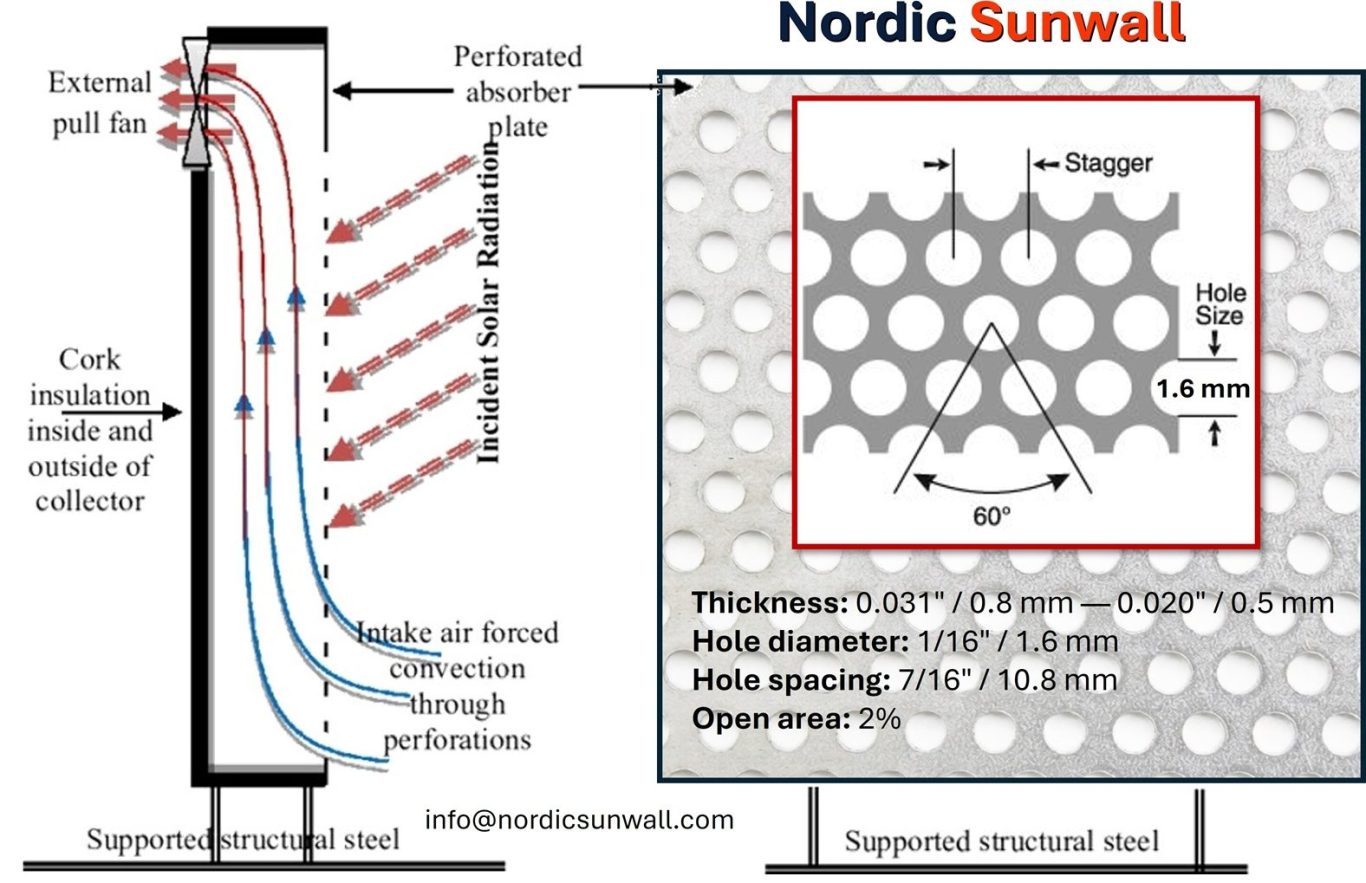
The Technical Secret: Why Micro-Perforations Outperform Large Holes
Most people assume bigger holes allow more airflow and deliver better performance. For solar air heating, the opposite is true.
Our plates use a precision pattern of micro-perforations — developed through extensive testing to achieve the optimal balance between airflow and heat absorption. Here is why this design is superior:
It is the same principle as a car radiator: narrower, denser channels deliver more heat to the air.
Result: More heat per square metre, delivered directly into your building.
What This Means for Your Building
Nordic Sunwall is designed to preheat the fresh air that your building already needs — not to replace your primary heating system. But this preheating delivers measurable savings.
A typical example for a mid-sized farm:
A multi-panel system delivers thousands of Watts of free heat on a sunny winter day. That heat is transferred to the fresh air supply. The incoming air is 25–35°C warmer than the outside air. When this preheated air enters the building, your existing heating system runs significantly less.
The result: Your gas or electric heating runs 40–60% less on sunny days — meaning lower bills, less equipment wear, and a smaller carbon footprint.
Actual results vary per building, insulation, ventilation volume, and local climate. Every building is different — that is why we offer a free, site-specific energy assessment with every quote.
The Bottom Line
A perforated solar air heater for your building is:
It does not replace your existing heating — it reduces how often it needs to run. That means lower bills, less wear on your equipment, and a smaller carbon footprint.
Ready to See What Nordic Sunwall Can Do?
Contact us for a free, no-obligation assessment. We will evaluate your wall, ventilation needs, and current energy costs. Then you will receive a fixed quote and a realistic payback analysis — with exactly how much you can save.
📧 info@nordicsunwall.com
🌐 nordicsunwall.com
We hebben je toestemming nodig om de vertalingen te laden
Om de inhoud van de website te vertalen gebruiken we een externe dienstverlener, die mogelijk gegevens over je activiteiten verzamelt. Lees het privacybeleid van de dienst en accepteer dit, om de vertalingen te bekijken.